Weekly ETF Reads
AI Debt Blowups Become Fodder for ETFs Aimed at Retail Investors by Lu Wang and Caleb Mutua
“Any random person who has read anything about the global financial crisis is going to know what these are. But will they actually buy an ETF based on it?”
One Bad Day: A levered-QQQ ETF Case Study by Dave Nadig
“All told, it is absolutely the case that the geared-ETF complex contributed to the Thursday selloff.”
Nvidia’s Plunge Exposes the Hidden Cost of Leveraged ETFs by Sumit Roy
“A fund designed to deliver twice the stock’s daily return has almost nothing to show for a period in which the stock rose by more than half.”
ETFs & Nvidia: Midterms, Investigations & Dip Buyers by Roxanna Islam
“639 ETFs have Nvidia within its top 15 holdings, and 1,070 ETFs total have exposure to Nvidia.”
ETF issuers weigh closures as launch pace heads for new record by Leo Almazora
“Cerulli found 88% cite a lack of assets as a factor in rationalization decisions, and 69% point to weak demand from key distribution partners.”
In a Rising Sea of ETFs, What Do Advisors Actually Want? by Griffin Kelly
“Perhaps unsurprisingly, advisors tend to stick with investment strategies that lean more traditional than novel.”
Vanguard Says Tax-Loss Inflows to Muni ETFs Likely to Stick by Martin Z. Braun
“ETFs account for 97% of the $76 billion in muni fund inflows this year.”
BlackRock Sees Billions in Crypto ETF Conversions. Security Fears Are Driving the Trade. by Kenneth Corbin
“The level of demand and interest has sort of been one way—up.”
Both sides of bitcoin, fairly told by Bob Pisani
“The long chapter on ETFs explains why security, cost, taxes, regulatory protection, and liquidity all strongly point to ETFs as the best vehicle for gaining exposure to bitcoin.”
(Note: Bloomberg’s Eric Balchunas and James Seyffart, authors of Both Sides of the Coin, recently joined me on Crypto Prime to discuss their new book. You can watch the interview here.)
ETF Post of the Week
We’ve reached the point in the year when fund companies start providing estimates of year-end capital gain distributions, which makes this an opportune time to reemphasize the tax efficiency of ETFs versus mutual funds. Let me explain.
Say you own shares of an actively managed mutual fund and another shareholder in the same fund wishes to sell their shares. In order to meet this redemption request, the manager of the mutual fund may need to sell stocks held by the fund to raise the cash necessary to pay this shareholder. When the mutual fund manager sells stocks owned by the fund for a gain, the mutual fund is required to distribute any net gains to all fund shareholders – including you! This is called a capital gain distribution, and it typically occurs toward the end of each year. Here’s the kicker: you owe taxes on this distribution if the mutual fund is held in a taxable account.
So, let’s recap. Another mutual fund shareholder needs cash for whatever reason, and as a result, you may be penalized with a taxable capital gain distribution. You didn’t sell your mutual fund shares at a gain. You didn’t receive an interest payment. You didn’t receive a dividend check. You didn’t do anything. But you may receive a tax bill, which hardly seems fair. What’s worse, these capital gain distributions are “phantom gains” in that the share price of the mutual fund is reduced by the amount of the capital gain distribution. Net-net, you’ve received a distribution that you didn’t ask for and may owe taxes on, even though you never sold a single share of your mutual fund.
Compare that with ETFs. If an ETF shareholder needs cash, they simply sell their ETF shares to another investor, just like they would Apple or Tesla stock. There’s no impact to you. In other words, there’s no need for an ETF manager (issuer) to sell stocks held by the ETF to raise cash. It gets even better. In the event ETF shares are ultimately redeemed with the ETF issuer, the unique ETF structure allows shares of underlying stocks to be delivered to Authorized Participants (APs) “in-kind.” This means shares of underlying stocks are exchanged for ETF shares without the ETF generally recognizing a taxable capital gain on the transaction. One benefit of this process is that ETF providers can shed their lowest cost basis shares, which have the largest capital gains. For example, if an ETF owns a bunch of Apple stock with a cost basis of $200 – and keep in mind, Apple is trading at around $360 right now – when ETF shares are redeemed by APs, the ETF provider can simply hand over that low cost basis Apple stock with no tax consequences. The benefit of this is that ETF providers can continually shed their lowest cost basis shares of stock, providing a huge tax advantage compared to mutual funds. Interestingly, mutual funds will typically do exactly the opposite, shedding their highest cost basis holdings in an attempt to minimize their capital gain distributions.
The bottom line is that with ETFs, you typically have much greater control over when you realize capital gains and pay taxes. With mutual funds, you’re much more exposed to the redemption activity and portfolio decisions of other shareholders and fund managers. While ETFs can certainly have capital gains distributions, they don’t tend to look like this…
Don’t see any ETFs on the list…
— Meb Faber (@MebFaber) November 10, 2026
ETF Chart of the Week
One of the year’s biggest stories has been Corgi’s entrance into the ETF arena. The firm has debuted a mind-boggling 220 ETFs this year, including the recent launch of 15 bond ETFs with fees as low as 2 basis points. Corgi has another 300+ ETFs in registration with the SEC. Morningstar’s Daniel Sotiroff:
“The asset management arm of an insurance startup is challenging conventional wisdom. Its basic plan appears to be undercutting the minuscule fees charged by the major asset managers. That means something along the lines of charging 0.03% for an ETF that will compete against incumbents charging 0.04%. Corgi started by applying that philosophy to a lot of thematic, leveraged, and inverse ETFs, where the fee cuts can be larger. It’s been a slow start, though.”
To Daniel’s last point, total assets in Corgi ETFs stand at around $600 million, or less than $3 million per ETF. While Corgi has the third-most ETFs of any issuer, its assets rank around 200th in the industry. It’s still very early for Corgi, but this might be one of the most fascinating charts I’m watching right now.
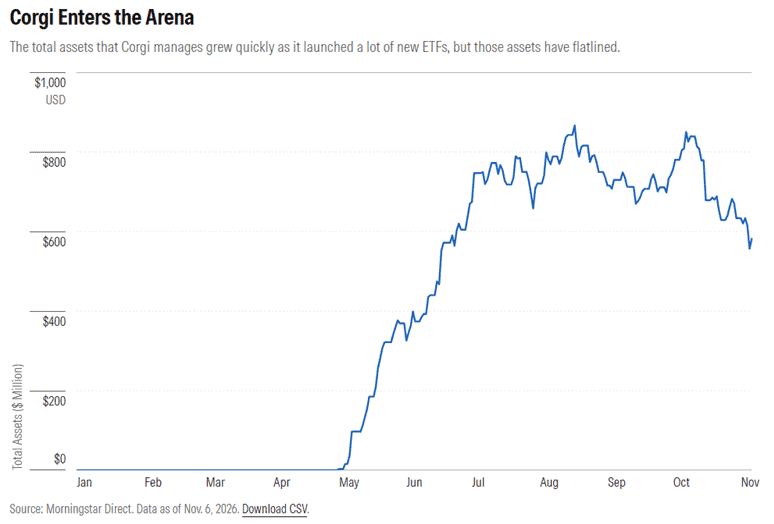
Source: Morningstar’s Daniel Sotiroff
ETF Prime Podcast
Last week’s ETF Prime featured Jay Jacobs, U.S. Head of Equity ETFs at BlackRock, and Tal Schwartz, Founder & CEO of Ai Funds. Jay discussed growing investor demand for the iShares Systematic Alternatives Active ETF (IALT), highlighted notable recent launches such as the iShares Nasdaq 100 ETF (IQQ), and explained how risk management is shaping investor interest across several iShares ETF categories. Tal introduced the Ai Funds High Conviction US Equity AI-Managed ETF (HIAI) and its proprietary AI investment model, while exploring how artificial intelligence could reshape the future of investing.