ETF Inflows & Outflows
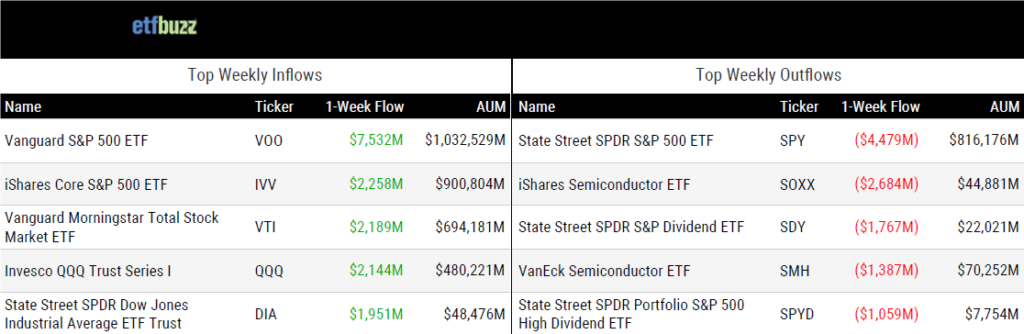
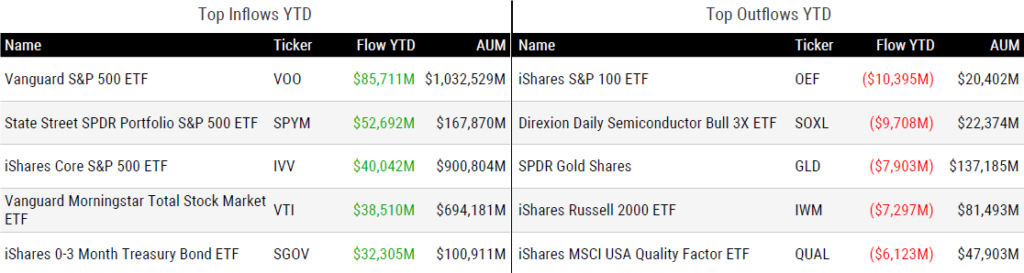
Performance Leaders & Laggards
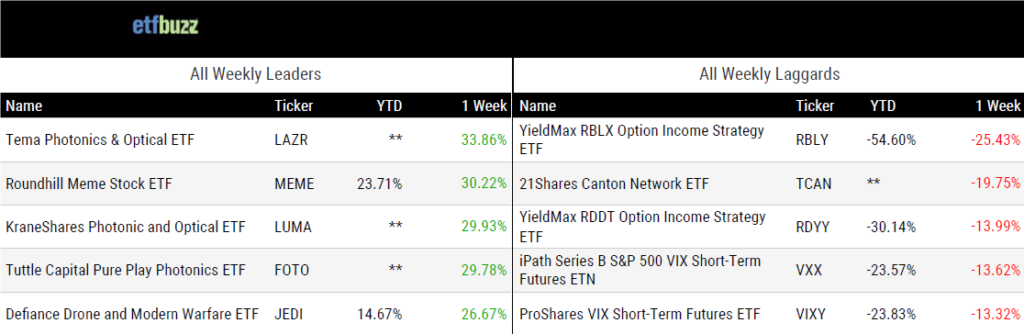
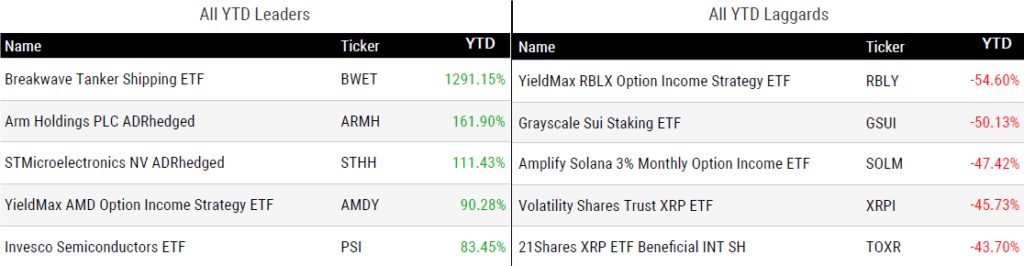
Source: ETF Action; flows and performance data as of 8/6/26; performance data excludes leveraged and inverse products
Weekly ETF Reads
2025 Was a Record Year for ETFs; 2026 Is Upstaging It by Cinthia Murphy
“Daily net inflows are averaging $5.7 billion in 2026, a 40% increase over 2025’s record pace.”
Why Highly Leveraged ETFs Are Still in Limbo at SEC by Emile Hallez
“That issuers are pursuing more unusual and extreme flavors of funds is a consequence of the success of the ETF wrapper.”
Banks Offload Risk from Leveraged ETFs With Exotic ‘Crash Puts’ by Yiqin Shen
“Crash puts serve the useful purpose of allowing the banks that service ETF providers a chance to purchase disaster insurance from investors with enough assets and risk tolerance to take the other side of the trade.”
Leveraged ETFs Need to Be Reined In by The Editorial Board at Bloomberg
“Regulators should require that brokerages limit access to complex ETFs to customers who have undergone an approval process like the one used for options trading.”
The Leveraged ETF Question Nobody Is Asking by Nicholas Phillips
“Should every underlying security automatically qualify to support a leveraged ETF?”
How a Few Hot Stocks Can Make ‘Twin’ Funds Act Like Strangers by Jason Zweig
“So far in 2026, the performance gap across large-cap growth index ETFs from Invesco, iShares, State Street and Vanguard is staggering.”
First U.S. spot bitcoin ETF to close as inflows dwindle, investors chase AI returns by Francisco Rodrigues
“Taken as a group, the funds have seen net outflows in each of the past three months.”
ETF Tokenization: Building the Next Layer of Market Infrastructure by Andres Rincon and Casey Yang
“The market appears to be developing along three paths: tokenized ETF exposure, issuer-led tokenized ETF shares and, further out, fully on-chain ETFs.”
Upcoming ETF Webinar
On behalf of the The ETF Institute and the New York Stock Exchange, I’ll be moderating a webinar this upcoming Tuesday, August 11th, covering some of the industry’s hottest topics: 351 exchanges, ETF share classes, and novel products.
I’ll be joined by an outstanding panel that includes: Brittany Christensen, Head of Business Development at Tidal Financial Group; Steve Cook, CIO at Harbor Capital Advisors; and Wes Gray, CEO at Alpha Architect.
You can register for free here!

ETF Post of the Week
Even if you don’t follow crypto closely, you’ve likely heard about the recent Coldcard hack, in which attackers exploited a flaw in how certain devices generated wallet seeds. Coldcard, produced by a Canadian company called Coinkite, had built a reputation among many bitcoin die-hards as the gold standard for securing the digital asset. The fact that these devices could be compromised has left some in the industry shaken and has stirred debate over whether the incident could accelerate flows into spot bitcoin ETFs, which rely on institutional-grade custody provided by third-party custodians. While that approach presents its own set of risks, it’s tough to deny that some bitcoin holders would rather entrust large ETF issuers and Coinbase with safeguarding their holdings than rely on a small, privately-held Canadian firm. And early indications suggest there could be real momentum behind a shift toward ETFs here.
One important note: This hack had absolutely nothing to do with bitcoin itself, only with how some Coldcard devices generated wallet seed phrases (and, thus, the private keys that allow users to access and transfer their bitcoin).
I’ll be discussing the potential ETF impact of this hack on next week’s Crypto Prime with Grayscale’s Head of Research, Zach Pandl.
NEW: Coldcard hack could spur greater migration to ETFs. What used to be seen as a bug by coiners (dorky boomer TradFi) may all the sudden seem like a feature (large, established financial institutions with decades of experience safeguarding client assets) esp vs a Canadian co w/… pic.twitter.com/k3tFLIiy9Z
— Eric Balchunas (@EricBalchunas) August 4, 2026
ETF Chart of the Week
Actively managed ETFs recently eclipsed $2 trillion in assets. A few fun facts:
-Dimensional is currently the largest active ETF issuer, with over $300 billion in total actively managed ETF assets.
-The largest actively managed ETF is the Dimensional U.S. Core Equity 2 ETF (DFAC), with nearly $50 billion in assets. That is closely followed by the JPMorgan Equity Premium Income ETF (JEPI), with over $45 billion.
-Active ETFs have taken in over $450 billion in new money so far this year, led by the Roundhill Memory ETF (DRAM) with $26 billion.
Investment News recently recapped a new report from UMB Fund Services and FUSE Research Network that found the following:
“When product executives at asset management firms were asked about their development priorities, 96% identified active ETFs as a major focus — more than any other vehicle by a wide margin. Meanwhile, 68% of managers report that active mutual funds are ‘not a focus’ of their product development plans, according to the FUSE survey. The vehicle that built the active management industry has, by the industry’s own admission, been deprioritized.”
The report concluded:
“The active ETF is no longer a potential future; it is the current reality of the US asset management landscape. For the modern asset manager, the challenge is to successfully translate their active alpha into the wrapper that the market now demands.”
I couldn’t have said it better.
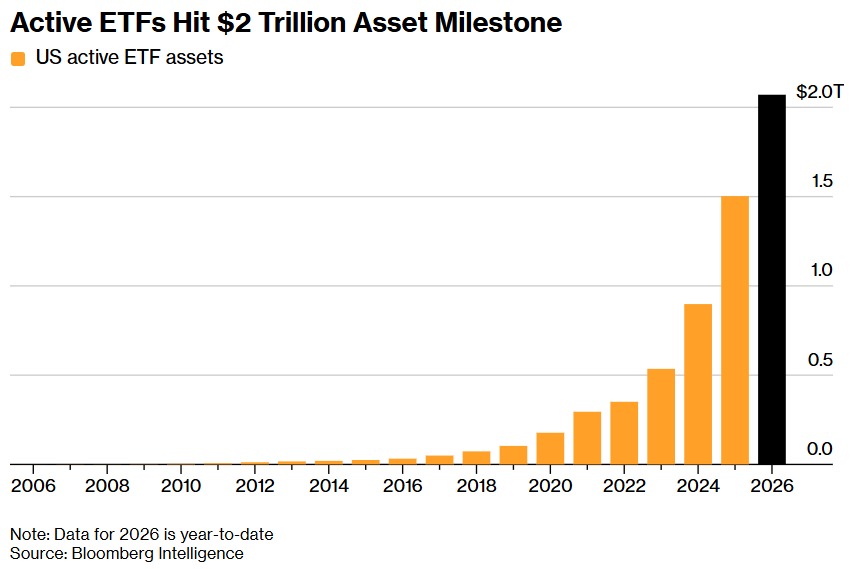
Source: Bloomberg’s Isabelle Lee
ETF Prime Podcast
Last week’s ETF Prime featured Rebecca Venter, Senior Fixed Income Client Portfolio Manager at Vanguard, and Jon Maier, Chief ETF Strategist at J.P. Morgan Asset Management. Rebecca shared the firm’s perspective on fixed income markets, discussed how clients are positioning their portfolios, and highlighted several ETFs, including Vanguard’s Target Maturity Corporate Bond ETF suite. Jon walked through the firm’s latest Guide to ETFs and discussed its U.S. ETF midyear outlook.