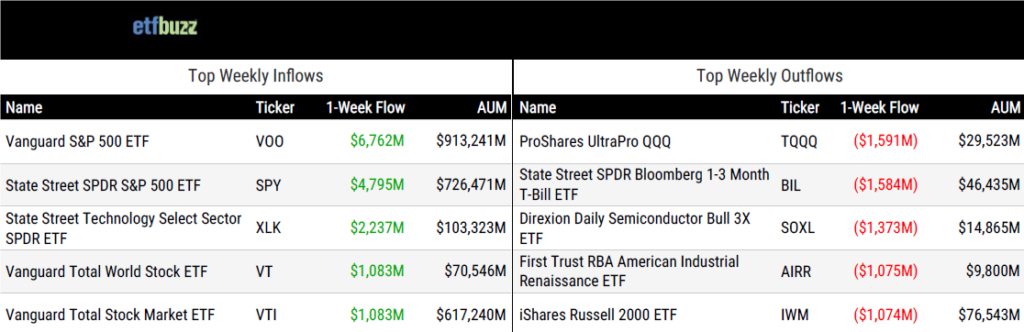
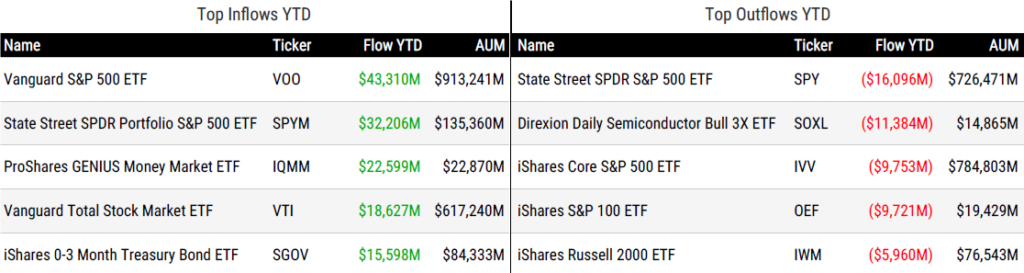
ETF Inflows & Outflows
Performance Leaders & Laggards
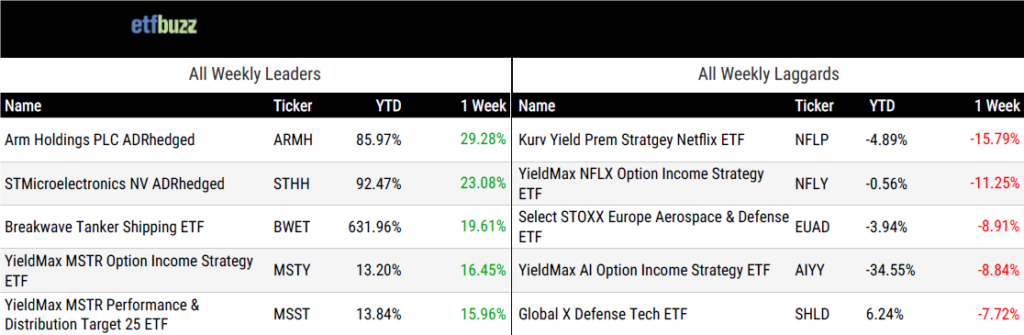
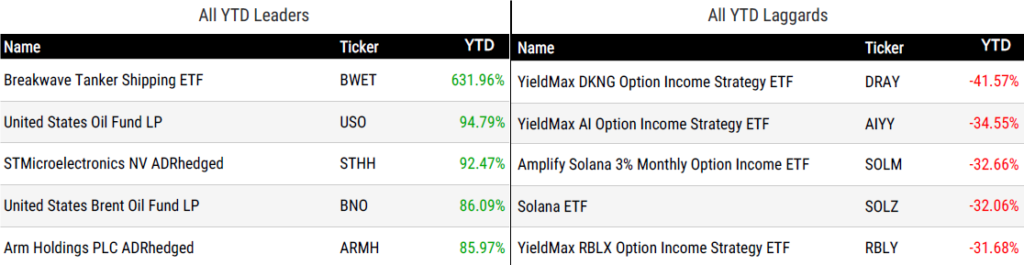
Source: ETF Action; flows and performance data as of 4/23/26; performance data excludes leveraged and inverse products
Weekly ETF Reads
Under circumstances not yet fully explained, BlackRock and State Street are filing to finally compete with Invesco’s QQQ ETF, after Nasdaq opens up index licensing by Brooke Southall
“A likely contributor is the new regulation that will make it easier for interesting new companies to join the index on an expedited basis.”
The Real Risk of SpaceX’s IPO by Michael Monaghan
“So we have a number of key elements emerging: a high-profile IPO with limited float, accelerated Nasdaq 100 inclusion, automatic buying at any price, new ETFs following identical rules and a feedback loop driven by flows rather than fundamentals.”
The Passive vs. Active Chart Everyone Misreads by Sumit Roy
“What it actually shows is that low-cost ETFs have replaced high-cost mutual funds.”
Active ETF adoption among RIAs nears $400B, but weaker funds are getting squeezed out by Leo Almazora
“For ETF issuers, success in the RIA channel increasingly depends on clear portfolio positioning, strong differentiation, and precise targeting of advisors whose investment approach aligns with the strategy.”
ETFs Are Quietly Rewiring Institutional Portfolios by Julie Segal
“U.S. and Canadian institutions have roughly doubled their use of ETFs over the past five years.”
Looking for an AI ETF? You Might Need an LLM for That by Jeffrey Ptak
“There were 47 exchange-traded funds with names that featured the terms ‘AI’ or ‘artificial intelligence,’ or to which Morningstar had assigned its ‘Artificial Intelligence’ thematic tag.”
Boutique ETF Rode Memory-Chip Stock Boom to a Billion Dollars in Ten Days by Sidhartha Shukla and Isabelle Lee
“The pattern is consistent: sharp idea, good ticker, retail discovery, options liquidity, flywheel.”
“It would be interesting to see if any issuer files for a ‘Fidelity Fee’ based share class for their ETFs.”
Prediction markets could soon be available in your retirement account by Contessa Brewer
“An ETF issuer’s job is to give investors access to investments they want and we see a lot of interest in prediction markets.”
Crypto giant GSR launches its first ETF to give investors an easy way to bet on the big 3 tokens by Helene Braun
“The move expands GSR’s business beyond trading and market making into asset management.”
ETF Posts of the Week
An ongoing industry debate intensified this past week after Fidelity began charging trading commissions of up to $100 on certain ETFs. The firm describes the fee as follows:
“This service fee will apply to a limited number of ETFs offered by providers that do not pay Fidelity a direct, asset-based fee to support their ETFs’ availability on our brokerage platform, including support for shareholder support services, the provision of calculation and analytical tools, and general investment research and education materials regarding ETFs.”
For now, the fee applies to a relatively small subset of ETFs. That list is expected to expand on June 1, though it will still represent only a small fraction of the broader ETF universe.
At the heart of the issue is a structural challenge for Fidelity and other brokerages. ETFs trade like stocks, meaning they are broadly accessible across platforms. That stands in contrast to mutual funds, which have historically paid for “shelf space” on brokerage platforms. As CityWire noted last week:
“Unlike mutual funds, which pay various fees for administration, distribution and shelf space, via Sub-TA ,12b-1 and wider revenue-sharing arrangements, sales of ETFs do not make much money for wealth platforms.”
This dynamic has become more pronounced since major brokerages shifted to commission-free ETF trading several years ago.
As investors continue to move toward ETFs, firms like Fidelity are becoming increasingly focused on how to replace the revenue once generated by mutual funds. That challenge is likely to grow as ETF share classes of existing mutual funds continue to roll out.
This will be a key story to watch. As major brokerages attempt to figure out ETF monetization strategies, they’ll also need to navigate a more competitive environment with platforms like Robinhood, who quickly pounced on the opportunity.
(Note: Ben Slavin of BNY and I discuss this in detail on ETF Prime, which you can watch below.)
Thanks for the tag, @HnieJo.
— Fidelity Investments (@Fidelity) April 18, 2026
We first want to clarify that an ETF service fee is a fee applied by Fidelity to ETF sponsors whose economics are not deemed sufficient to cover the cost of fund key operations, technology, and client support that help maintain Fidelity’s open…
Stuck paying $100 for an ETF with your old brokerage? Time for an upgrade.
— Robinhood (@RobinhoodApp) April 20, 2026
Transfer into Robinhood and we’ll match it:
✅ Eligible customers get a minimum 0.75% match
✅ Earn up to 4% match when you transfer $10K or more in margin balance
✅ Available to new and existing US…
ETF Chart of the Week
Strategas’ Todd Sohn notes that ETF inflows have significantly accelerated in April:
“Equity ETF flows sit in their 70th percentile over the trailing year, but that’s going to change quickly given April’s torrid pace. Equity flows are averaging +$7.4 Bn per day, easily a record and up meaningfully from March’s +$2.9 daily average.”
For the year, equity ETFs have now taken in over $375 billion.
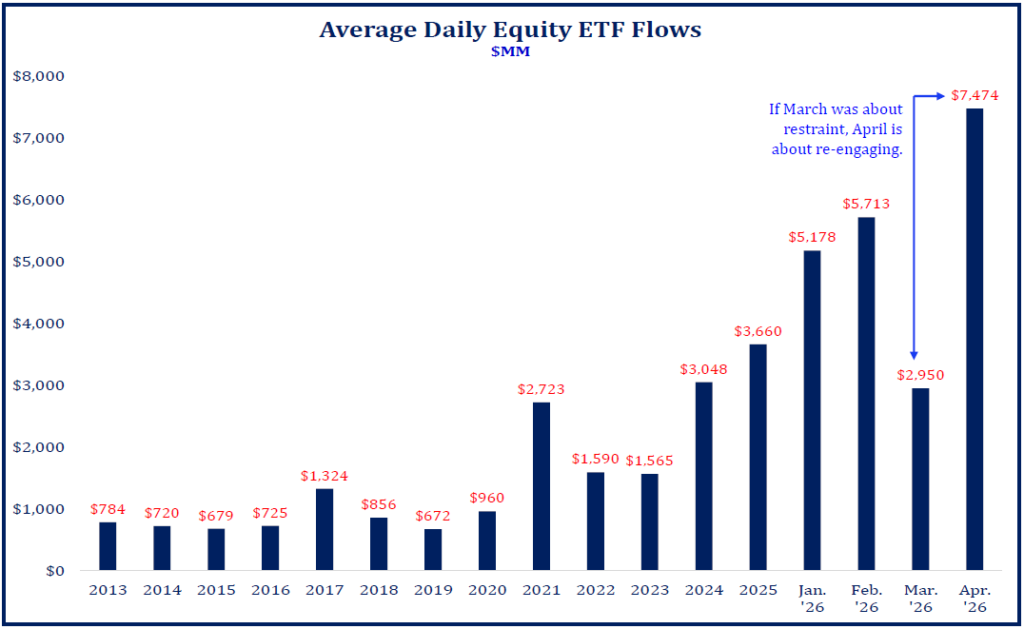
Source: Strategas’ Todd Sohn
ETF Prime Podcast
Last week’s ETF Prime featured Stacey Morris, Head of Energy Research at VettaFi, and Ben Slavin, Global ETF Industry Lead at BNY. Stacey unpacked how the Iran conflict is impacting energy ETFs. Ben toured the evolving ETF landscape, from share classes to tokenization and new product innovation.
Crypto Prime Podcast
Eric Balchunas, Senior ETF Analyst at Bloomberg Intelligence, joined me on last week’s Crypto Prime to dive into crypto ETF flows, the competitive landscape, and the long-term impact of tokenization on ETFs.