ETF Inflows & Outflows
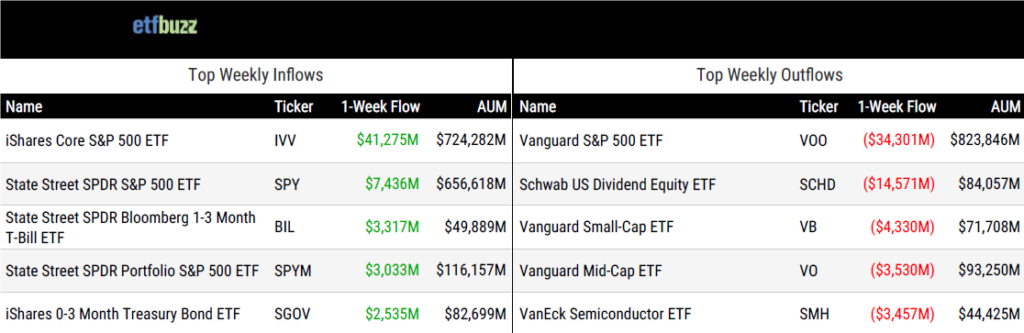
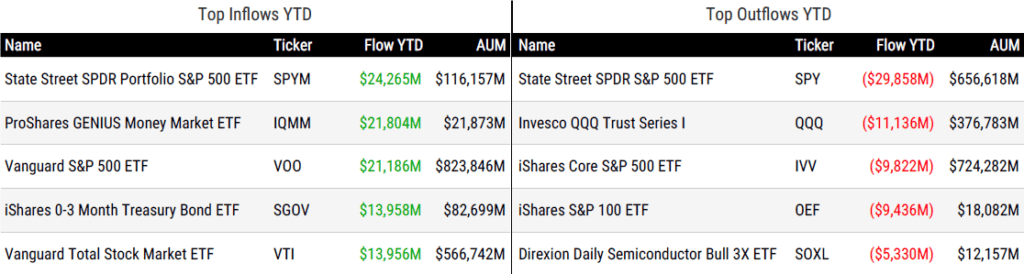
Performance Leaders & Laggards
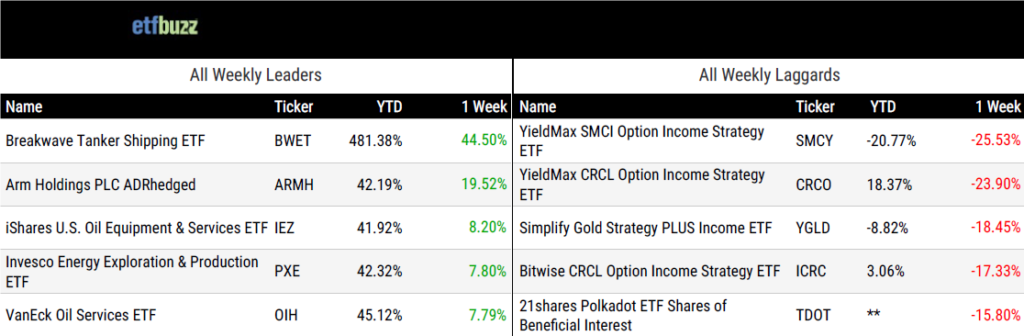
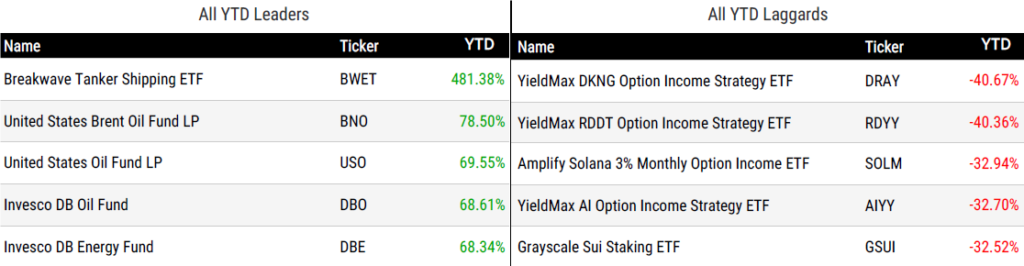
Source: ETF Action; flows and performance data as of 3/26/26; performance data excludes leveraged and inverse products
Weekly ETF Reads
The Once-Sober ETF Industry Finds a Home on a Vegas Casino Floor by Katie Greifeld and Vildana Hajric
“The industry has taken a flying leap over the line that separates investing from gambling.”
The State of the ETF Industry: 2026 Exchange Edition by Cinthia Murphy
“It took us about 24 years to get to the first 2000 ETFs listed in the U.S. It took us just nine years to get to 5000 ETFs.”
Why the $100M AUM Survival Limit May No Longer Matter by Mallika Mitra
“The cost of launching an ETF and managing an ETF has come down a lot.”
Financial Advisors Are Turning Entire Client Portfolios Into ETFs. What’s Behind the Trend. by Lewis Braham
“It’s not really a tax dodge. It’s just deferring the eventual capital gains.”
Demystifying 351 ETF Exchanges by Victor Haghani, James White, Jerry Bell
“Another important consideration for participating in a 351 exchange is that you must really like the new ETF that you’re exchanging into.”
ETFs Improve Odds of Success for Active Managers by Bryan Armour
“Active ETFs mostly carve their edge against active mutual funds with low fees, but their advantage may not stop there.”
Morgan Stanley enters bitcoin ETF race with market-leading low fee by Helene Braun
“The fund would be the first spot bitcoin ETF issued directly by a major U.S. bank.”
Franklin Templeton Debuts ETFs That Trade in Crypto Wallets 24/7 by Isabelle Lee and Sidhartha Shukla
“You can think of this as a new distribution channel.”
Vanguard’s Brokerage Arm Is Now Offering Crypto ETFs. They’ve Been Tanking. by Lewis Braham
“Vanguard has historically taken a paternalistic attitude toward its clients, attempting to foster a culture of long-term investing instead of short-term speculation.”
ETF Post of the Week
ETFs have accounted for an average of 37% of total U.S. stock market trading volume in March – the highest monthly share on record. This is often interpreted as evidence that ETFs amplify market volatility. I see it differently.
ETFs function as liquidity release valves for the underlying markets, not as drivers of excess volatility. During periods of market stress, trading volumes in ETFs tend to rise because institutions use them as efficient tools to transfer risk and hedge exposure.
In other words, ETF activity is more a reflection of market conditions than a cause of them.
ETF trading is taking over the US stock market:
— The Kobeissi Letter (@KobeissiLetter) March 24, 2026
ETFs now account for 37% of total US stock market volume, the highest monthly average on record.
This percentage has soared +13 points since the start of 2025.
This also surpasses the previous peaks of ~36% during the 2020… pic.twitter.com/V8zb88DKad
ETF Chart of the Week
ICI released a new report last week, Trends in the Expenses and Fees of Funds. The report noted that over the past nine years, expense ratios for index equity and bond ETFs have declined by 33% and 50%, respectively. ICI:
“ETF shareholders tend to invest in funds with below-average expense ratios. In 2025, the simple average expense ratio for index equity ETFs (the average for all index equity ETFs offered for sale) was 0.45%. The asset-weighted average expense ratio for index equity ETFs (the average shareholders actually paid) was much smaller, 0.14%, indicating that ETFs with lower expense ratios tend to have greater assets (Figure 7). In recent years, competition and economies of scale within the ETF industry have put downward pressure on both equity and bond ETF expense ratios. New ETF sponsors have entered the marketplace to compete for market share, and the number of equity and bond ETFs has skyrocketed. Even with the steady stream of new types of equity and bond ETF offerings, which can have a wide range of expense ratios, the rapid growth in ETF total net assets has enabled many funds to reduce their expense ratios because of economies of scale.”
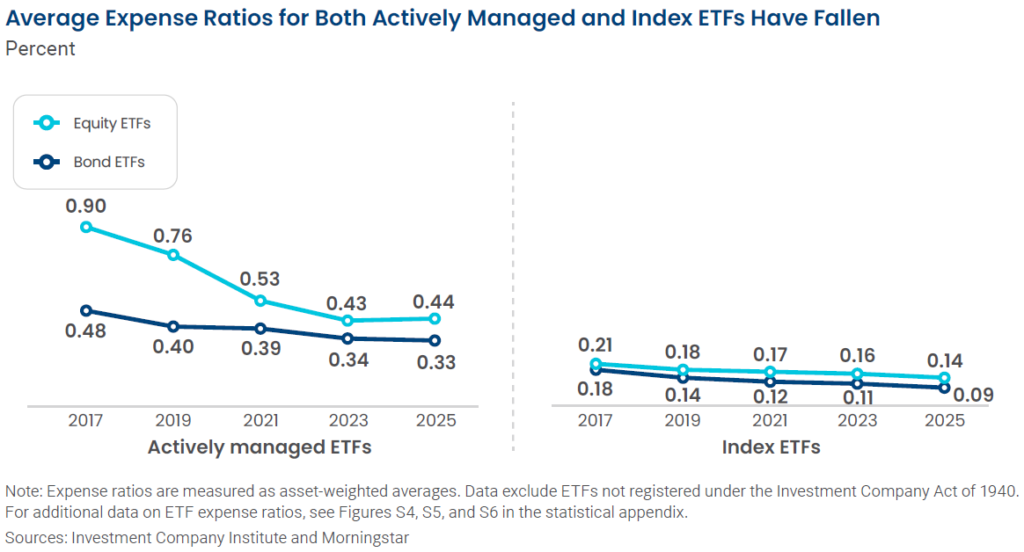
Source: ICI
ETF Prime Podcast
Last week’s ETF Prime featured Michael Cohick, Director of Product Management at VanEck, and Matt Camuso, Head of ETF Solutions at Baron Capital. Michael broke down the firm’s lineup of TruSector ETFs and how they aim to address tracking error caused by regulatory diversification limits – constraints that can force traditional sector funds to underweight the largest companies in their benchmarks. Matt discussed the firm’s recent entry into the ETF space and outlined its distinctive approach to actively managed growth equity investing, including the Baron First Principles ETF (RONB).
CNBC ETF Edge
I had the pleasure of joining CNBC’s Dominic Chu and Dynamic Beta Investments’ Andrew Beer to discuss managed futures ETFs. We covered the potential diversification benefits, increasing investor interest in the category, the importance of education around these strategies, and more (there’s a nice recap here). Enjoy!